YouTube
BaijaNath Temple Achham | Detail Story of Baijanath Dham
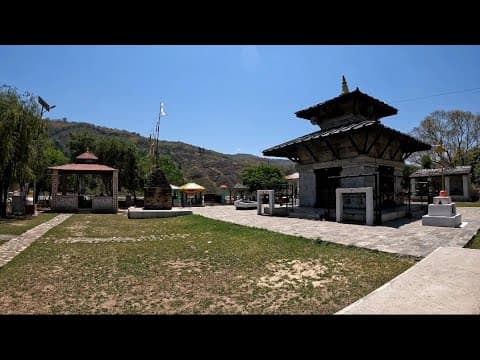
Baidyanath Dham (वैद्यनाथ धाम), situated in Sanfebagar Municipality-1 at an elevation of 920 metres, is one of the four legendary Char Dham holy pilgrimage shrines of Nepal and the spiritual epicenter of Achham District. Perched at the sacred confluence (Triveni sangam) of the holy Budhiganga River and the Saraswati (Vriddhaganga) River, Baidyanath is venerated as an extraordinarily auspicious Shaivite pilgrimage sanctuary mentioned prominently in the ancient Manaskhanda of the Skanda Purana. According to Hindu religious tradition and scriptural lore, this sacred river confluence is where the mythical Lanka king Ravana performed intense penance (tapasya) dedicated to Lord Shiva, severing his ten heads one after another. Lord Shiva, pleased by his devotion, appeared in the divine form of a celestial physician ('Baidya') to restore his heads and grant him boons, thereby consecrating the sanctuary as 'Baidyanath' (Lord of Physicians). Today, pilgrims bathe in the sacred sangam to seek spiritual purification, health, and relief from chronic ailments. The temple complex features ancient stone sculptures, a traditional multi-tiered sanctum, and the renowned Baidyanath Ved Vidyashram, a residential Vedic academy preserving traditional Sanskrit chanting, scriptures, and ritual learning. During the grand festival of Maha Shivaratri, tens of thousands of pilgrims, sadhus, and cultural troupes from across Sudurpashchim, Karnali, and Northern India converge here for sacred rituals, holy dips, and festive cultural celebrations along the riverbanks.
Baidyanath Dham (वैद्यनाथ धाम), situated in Sanfebagar Municipality-1 at an elevation of 920 metres, is one of the four legendary Char Dham holy pilgrimage shrines of Nepal and the spiritual epicenter of Achham District. Perched at the sacred confluence (Triveni sangam) of the holy Budhiganga River and the Saraswati (Vriddhaganga) River, Baidyanath is venerated as an extraordinarily auspicious Shaivite pilgrimage sanctuary mentioned prominently in the ancient Manaskhanda of the Skanda Purana. According to Hindu religious tradition and scriptural lore, this sacred river confluence is where the mythical Lanka king Ravana performed intense penance (tapasya) dedicated to Lord Shiva, severing his ten heads one after another. Lord Shiva, pleased by his devotion, appeared in the divine form of a celestial physician ('Baidya') to restore his heads and grant him boons, thereby consecrating the sanctuary as 'Baidyanath' (Lord of Physicians). Today, pilgrims bathe in the sacred sangam to seek spiritual purification, health, and relief from chronic ailments. The temple complex features ancient stone sculptures, a traditional multi-tiered sanctum, and the renowned Baidyanath Ved Vidyashram, a residential Vedic academy preserving traditional Sanskrit chanting, scriptures, and ritual learning. During the grand festival of Maha Shivaratri, tens of thousands of pilgrims, sadhus, and cultural troupes from across Sudurpashchim, Karnali, and Northern India converge here for sacred rituals, holy dips, and festive cultural celebrations along the riverbanks.
2 available
1 available
YouTube
BaijaNath Temple Achham | Detail Story of Baijanath Dham
Discover More

Binayak Panchadewal (विनायक पञ्चदेवल — Five Temples of Binayak) is a magnificent group of five medieval dry-stone Shikhara-style beehive temples situated in Panchadewal Binayak Municipality-3, Achham District, along the historic Mid-Hill Highway at an elevation of 1,345 metres. Listed as a protected national monument by the Department of Archaeology (DOA), this architectural masterpiece stands as one of the most significant and intact archaeological relics of the medieval Khas-Malla Empire in western Nepal. An ancient stone inscription carved into the monumental lintels records that these five Shikhara devals were constructed in Saka Era 1212 (1337 BS / 1290 CE) during the reign of Khas King Akshay Malla (अक्षय मल्ल). Renowned historian and antiquarian Yogi Naraharinath extensively documented the site, deciphering its Khas script inscriptions and linking the monuments to the imperial stone-masonry traditions centered at the Sinja capital of the Khas Kingdom. Each deval is erected with precision dry-stone masonry, featuring intricately carved doorframes, floral relief motifs, geometric lintels, and crowning ribbed stone amalaka capitals. Standing gracefully on a raised stone terrace in the heart of Binayak town, the monuments provide invaluable archaeological insight into the artistic heights, Shaivite devotional practices, and architectural engineering of 13th-century Western Nepal. The site is easily accessible to cultural travelers traversing the Mid-Hill Highway connecting Karnali and Sudurpashchim.

Mangalsen Durbar (मङ्गलसेन दरबार — Achham Palace), situated at an elevation of 1,746 metres in the district headquarters of Mangalsen Municipality, is the historic royal palace of the Achhami Rajas and the foremost civic heritage landmark of Achham District. Originally commissioned by King Tikabhuk Shah and completed in 1935 BS (1878 CE) under his son King Dal Bahadur Shah, the palace stands as a grand testament to the historical Baise Rajya principality of Achham. Architecturally, Mangalsen Durbar was constructed in an imposing three-story syncretic style combining classical Khas fortress masonry with intricate Newari wood-carving aesthetics reminiscent of the Kathmandu Valley durbars. The structure features elaborately carved wooden multi-bay windows, courtyards, and thick dressed-stone walls. Tragically, the historic palace was completely destroyed during a fierce conflict battle on the night of Falgun 4, 2058 BS (February 17, 2002). Following decades of civic advocacy, the Government of Nepal executed a faithful multi-million rupee architectural reconstruction to restore the palace to its original 19th-century splendor. Today, the restored Mangalsen Durbar functions as a premier cultural heritage monument, district museum, and civic landmark. Overlooking the scenic Mangalsen valley bowl with sweeping views of surrounding terraced hillsides, the palace offers visitors an immersive journey into the medieval kingship, wartime history, and resilient architectural rebirth of Far-Western Nepal.

Ramaroshan Wetland Complex (रामारोशन क्षेत्र), renowned across Far-Western Nepal as 'Barha Banda, Athara Khanda' (बाह्र बण्ड, अठार खण्ड — Twelve Lakes and Eighteen Grasslands), is a breathtaking high-altitude alpine wetland plateau and biodiversity sanctuary situated at an elevation of 2,500 metres in Ramaroshan Rural Municipality, Achham District. Nestled amidst pristine temperate forests of blooming rhododendron, Himalayan oak, and blue pine, Ramaroshan is considered the premier eco-tourism wonderland and wilderness trekking destination of Achham. The wetland complex encompasses twelve natural freshwater lakes of glacial and tectonic origin, each with distinct characteristics, headed by Jigale Lake (जिगाले ताल), an expansive waterbody shaped like a natural English 'C' or 'Y', and Mathillo Dhaune Lake, celebrated as the deepest. Surrounding the lakes are eighteen sprawling alpine meadows (patans), most notably Kinemini Chaur (किनेमिने चउर), through which the crystal-clear Kailash Khola serenely meanders. The plateau serves as a vital ecological haven for endangered wildlife including the musk deer, Himalayan monal (Danfe), cheer pheasant, and leopard cat. Beyond its extraordinary ecological value, Ramaroshan holds deep cultural significance as a sacred grazing realm and ancient pilgrimage landscape. Trekkers ascending to Ramaroshan enjoy panoramic vistas of Mount Saipal (7,031m) and the Api Himal massif to the northwest, as well as dramatic cascading waterfalls including Bange Chhahara. In 2026, the Government of Nepal formally recognized the corridor connecting Ramaroshan to Badimalika as a vital regional protected forest sanctuary.

Alamdevi Temple (आलमदेवी मन्दिर), situated in Lasargha within Kaligandaki Rural Municipality Ward 3 of Syangja District, is one of the most historically significant and sacred pilgrimage shrines in western Nepal. Venerated as the ancestral tutelary deity (Kuldevi) of the Shah kings of Nepal, the shrine traces its spiritual origin back over seven centuries. According to historical chronicles, when Prince Mincha Khan and his descendants established the principality of Nuwakot in Syangja and later expanded toward Kaski and Lamjung, Alamdevi was established as their protective sovereign deity. To this day, royal priests and state representatives continue to conduct solemn rituals here during major national festivals. A fascinating and distinctive ritual feature of Alamdevi is its open-air architecture and priestcraft tradition. Unlike typical multi-tiered Hindu pagodas, the main sanctum is a subterranean, roofless pit covered by stone and sacred sal trees, where the deity is worshipped as a hidden divine force. Furthermore, in an enduring testament to historic syncretism between the hill Magar populace and the ruling dynasty, the chief officiating priests (pujaris) belong strictly to the Rana Magar clan. Only the appointed Magar priest is permitted to enter the inner sanctum to perform esoteric Vedic-Tantric rituals and offer daily oblations. Perched on a forested hill overlooking the sweeping bends of the Kali Gandaki valley, Alamdevi attracts tens of thousands of pilgrims, particularly during Chaitra Dashain and the autumn Bada Dashain festivals. Devotees visit from across Nepal and India to seek blessings for protection, courage, and prosperity. The shrine is accessible via a motorable road branching off from the Siddhartha Highway at Waling or Galyang through scenic rural ridgelines.

Amar Narayan Temple (अमर नारायण मन्दिर), situated in Tansen Municipality Ward 3 of Palpa District, is a masterpiece of early 19th-century pagoda architecture and classical Nepali woodcarving. Commissioned in 1806 AD (1863 BS) by General Amar Singh Thapa, the legendary Gorkhali military commander and hero of the Anglo-Nepal War during his tenure as governor of Palpa, the temple was dedicated to Lord Vishnu. The structure is built in classical triple-roofed pagoda style, distinguished by intricate wooden roof struts embellished with erotic carvings and depictions of Hindu deities, rivaling the artistic brilliance of Kathmandu Valley artisans. The temple is encircled by a high stone perimeter wall known locally as the 'Great Wall of Tansen', preserving an inner courtyard paved with flagstones and blessed by natural cold-water perennial stone spouts (Dhunge Dhara). Devotees from throughout the hill districts visit Amar Narayan Temple during Haribodhini Ekadashi and Janmashtami, admiring its serene historic ambiance and classical architectural elegance.

Ambikeshwari Bhagwati Temple (अम्बिकेश्वरी भगवती मन्दिर), gracefully situated along the tranquil banks of the Sechha (Katuwa) River in Ambabali within Ghorahi Sub-Metropolitan City-19, is the premier Shaktipeeth and supreme mother-goddess pilgrimage sanctuary of the Dang Valley. Celebrated in regional scriptures and Hindu lore as one of the 51 sacred Shaktipeeths, legend recounts that the right ear (*Karna*) of Sati Devi fell at this consecrated spot while Lord Shiva roamed the cosmos carrying her physical form. The temple houses an aniconic natural rock shrine representing the divine feminine energy, embellished with sacred silver plating, gilded ornaments, and traditional tridents. The pagoda-style main temple is complemented by subsidiary shrines dedicated to Lord Ganesh, Bhairav, and Shiva, all surrounded by sprawling banyan and peepal trees providing cool shade. During Navaratri, Dashain, and Chaite Dashain, Ambikeshwari becomes the vibrant focal point of western Nepal's religious life, echoing with sacred Vedic hymns, devotional *bhajan-kirtan*, and traditional panche baja music. Pilgrims from Dang, Pyuthan, Rolpa, Banke, and cross-border regions visit to seek blessings for protection, prosperity, and spiritual fulfillment.